
Developing the Next Potato Variety Takes a Whole Region
Updated: May 29
Report from University of Maine

Multi-state Hatch-funded collaboration strengthens food security, supports growers and builds climate resilience across the Eastern U.S.
From the heat of Florida to the short growing seasons of northern Maine, developing a successful potato variety for the Eastern United States requires far more than a single field trial or one university’s expertise. It takes a coordinated regional effort built on decades of research collaboration, shared resources, and scientific innovation.
Supported through Hatch Multi-State funding, researchers from the University of Maine, Cornell University, Penn State, North Carolina State University and Ohio State University are working together to develop potato varieties that can withstand emerging diseases, changing climate conditions and evolving market demands while supporting one of the region’s most economically important crops.
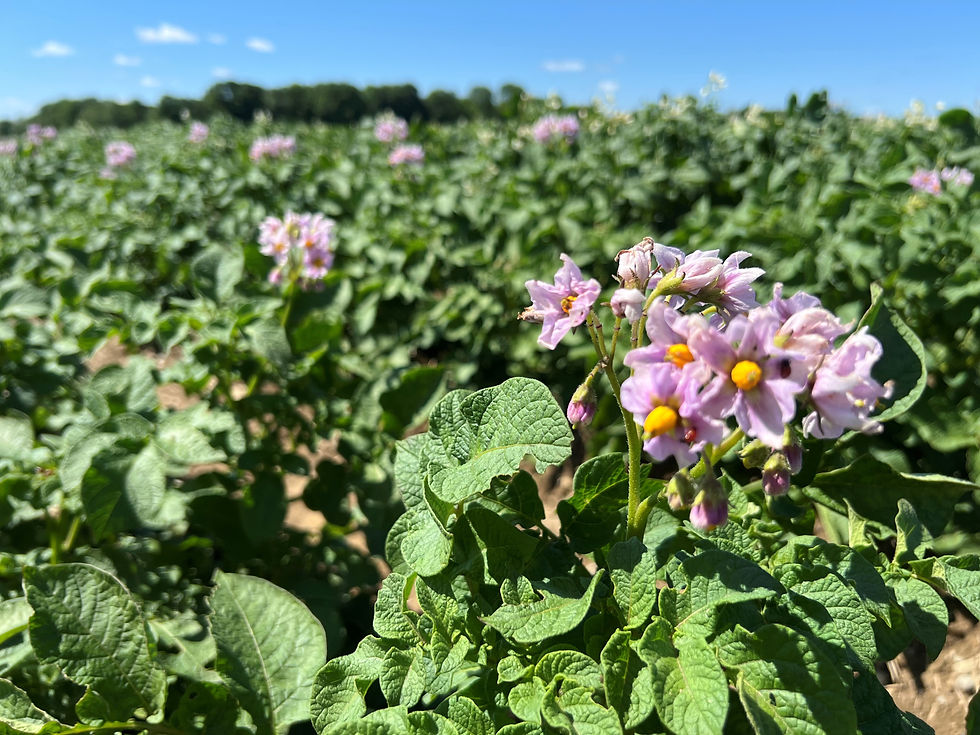
Potatoes remain a top-three vegetable crop across many Eastern states, generating approximately $500 million annually in cash receipts. But potato production carries significant risk for growers, with production costs often exceeding $3,000 per acre. Diseases such as Late Blight and Pink Rot can devastate an entire crop, threatening the livelihoods of farm families and the stability of regional food systems.
“Climate conditions and disease pressures do not stop at state lines,” the researchers note. “Developing resilient potato varieties requires coordinated testing across diverse environments throughout the region.”
That regional coordination is at the center of the project’s success.
The University of Maine manages the regional seed nursery, while field trials and specialty screening efforts occur across multiple states. Cornell University evaluates potato clones for Golden Nematode resistance. Penn State screens for common scab and Late Blight resistance. North Carolina State University tests heat tolerance under warmer Southern growing conditions. Additional trials throughout the region help researchers identify potato varieties capable of thriving in a wide range of climates and production systems.
The project combines traditional breeding methods with advanced tools such as marker-assisted selection and genomic modeling to accelerate the development of improved varieties. Researchers also rely on an innovative Variety Data Management digital platform that allows collaborators across institutions to share and analyze data in real time, helping identify the strongest candidates for commercial production.

The results are already reshaping the potato industry across the Northeast and beyond.
Over the past five years, the collaboration has released 13 commercially viable potato varieties. Five of those varieties have already reached the “Top 100” list for U.S. certified seed production.
In 2024 alone, varieties including Caribou Russet and Lamoka were planted on nearly 4,000 seed acres in Maine and New York, representing a seed value of approximately $11.9 million. Those seed crops have the potential to plant nearly 34,000 acres of potatoes, resulting in an estimated downstream crop value exceeding $110 million.
Nationally, potato varieties released through the project since 2007 represent an estimated seed value of $24.1 million and a potential production value of more than $223 million.
Beyond economic impact, the project advances broader regional priorities around sustainability, climate adaptation, and resilient food systems. By developing potato varieties with stronger natural disease resistance, researchers are helping reduce the need for chemical inputs while lowering production risks for growers and supporting environmental stewardship.
The work also reflects the Northeast land-grant system’s broader commitment to collaborative research that strengthens rural economies and food security across the region. The Northeast Agenda, a regional framework developed by Northeast land-grant universities and experiment stations, emphasizes the importance of resilient food systems, climate adaptation, and cross-state collaboration to address shared challenges.
Researchers say the potato breeding program demonstrates how regional partnerships can deliver practical solutions that benefit both producers and consumers.
“Developing resilient, sustainable and equitable food systems requires institutions to work together across disciplines and across state boundaries,” the Northeast Agenda notes.
For growers, the impact is tangible: more reliable crops, lower disease losses and potato varieties better suited to changing environmental conditions. For consumers, it helps ensure a stable supply of one of the nation’s most affordable and nutritious staple foods.
And for the Northeast region, the project highlights how coordinated agricultural research investments can strengthen communities, sustain working lands, and support the long-term vitality of the agricultural economy.


